
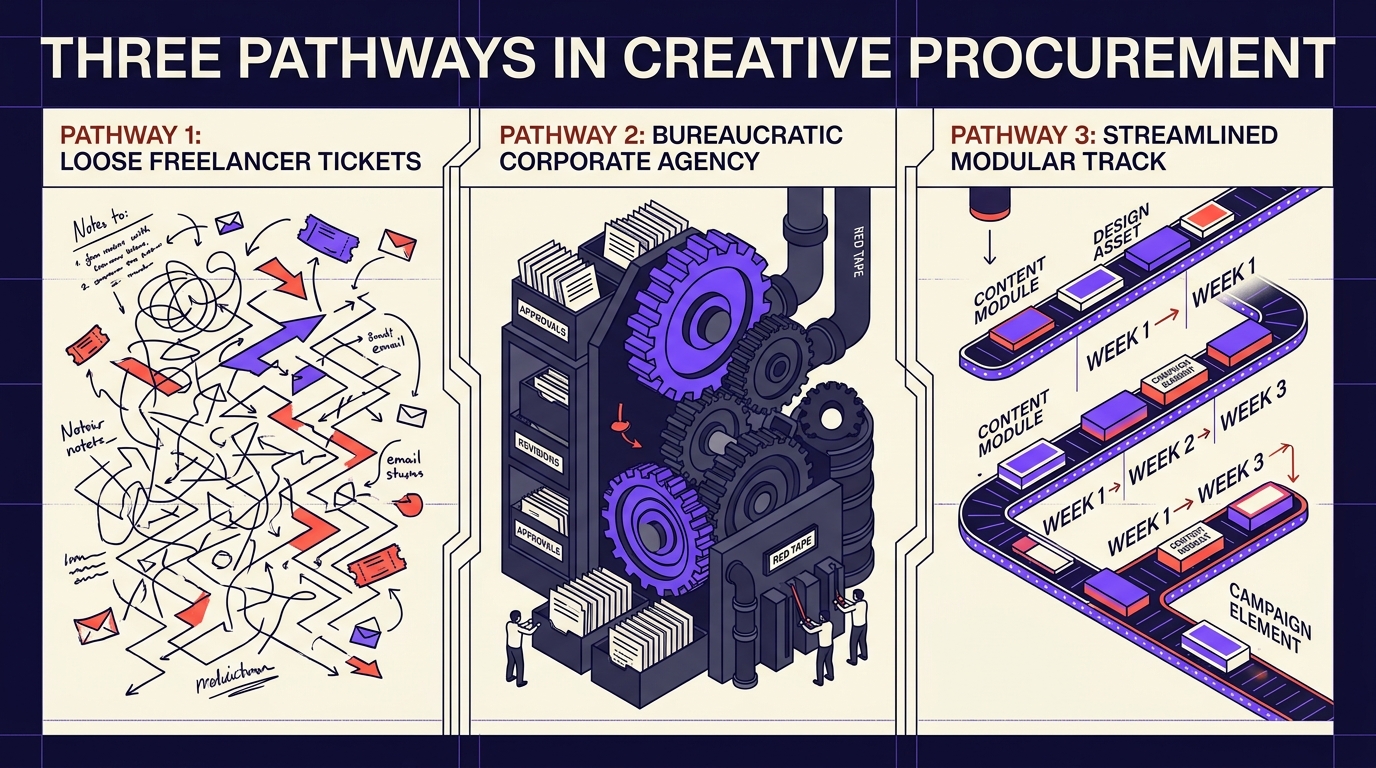
For communications directors and marketing leads, managing a recurring content calendar is rarely a question of creative vision. It is almost always a procurement and workflow bottleneck.
When campaigns, annual impact reports, funder presentations, and multi-channel motion assets need to roll out continuously, organizations typically evaluate three traditional paths: hiring ad-hoc freelancers, retaining a traditional agency, or opening a full-time in-house position. Each comes with hidden operational costs that rarely appear on the initial quote.
This guide breaks down the true economics, turnaround velocity, and delivery friction of each model, and why an embedded, weekly design and animation retainer has become the standard for established organizations.
Quick Summary: Model Comparison at a Glance
| Model | Typical Monthly Cost (CAD) | Turnaround & Rhythm | Key Risk / Friction Point | Best Suited For |
|---|---|---|---|---|
| Ad-Hoc Freelancer | $1,500 to $4,000+ (Per project) | Unpredictable; dependent on current freelance availability | Onboarding fatigue, style inconsistency, lack of emergency capacity | One-off, isolated projects with flexible deadlines |
| Traditional Creative Agency | $7,500 to $15,000+ | Multi-week review cycles mediated by account reps | High billable markups ($150 to $250/hr), rigid change orders, overhead | Large national rebrands with multi-department stakeholder trees |
| Full-Time In-House Hire | $6,500 to $9,000+ (Salary + benefits) | Dedicated 40 hrs/wk, but single-skill bound | High fixed overhead, recruitment lag, idle downtime between major campaigns | Large enterprises with uniform daily production demands |
| Embedded Content Retainer | $2,500 to $5,000 (Fixed monthly) | Planned weekly drops (W1 to W4) with dedicated production slots | Requires clear monthly priority planning at kickoff | Established non-profits, foundations, and teams publishing regularly |
The Freelancer Roulette: The Cost of Perpetual Onboarding
On paper, hiring a freelancer per project feels like the lowest financial commitment. You only pay for what you commission. In practice, communications teams spend their most valuable currency, time, managing the relationship.
- The Onboarding Tax: Every new brief requires explaining brand guidelines, tone, font licensing, and organizational sensitivities all over again.
- Visual Fragmentation: A freelancer hired in March uses different typography hierarchy and color palettes than the freelancer hired in July. Within two quarters, public-facing materials look fragmented.
- Availability Gaps: When an urgent legislative update or campaign milestone arises, your go-to contractor is often booked on another studio’s project.
The Agency Trap: Paying for Account Layers Instead of Execution
Traditional creative agencies offer high polish, but their business model is built on overhead: account managers, project coordinators, senior strategists, and agency markups. A simple update to an annual report or a set of 10 social cutdowns often requires multiple status meetings and billable change orders.
When you communicate through an account manager rather than the artist actually animating the keyframes or laying out typography, nuance gets lost in translation. Turnaround times stretch from days into weeks.
The In-House Hire: High Fixed Overhead and Skill Lock-in
Hiring a full-time multimedia designer solves availability, but for established foundations and non-profits, it introduces fixed overhead that does not scale with campaign rhythms. In Canada, a senior designer commands $75,000 to $95,000 CAD base salary, before benefits, software licenses, equipment, and payroll taxes.
Moreover, visual communications require diverse disciplines: one week demands accessible print PDF layout for an AGM report, the next requires broadcast-grade kinetic type and character animation, and the next requires bilingual social resizing. Finding all of those competencies at a senior level in a single hire is exceptionally rare.
The Solution: The Embedded Content Retainer
An embedded monthly retainer eliminates procurement friction by replacing transactional quoting with a predictable production rhythm. Rather than scoping individual invoices, you secure dedicated senior production capacity every month for a flat, transparent fee.
Why Broadcast & Agency Experience Changes Delivery
With 14+ years of experience delivering under rigid broadcast television schedules and fast-paced agency campaigns, the production process is built around zero-failure operational discipline:
- Seamless Workflow Integration: I adapt directly to how your team operates, whether you coordinate through Slack, Microsoft Teams, dedicated project boards (Asana, Notion, Trello), or email. No foreign client portals or administrative hurdles.
- Broadcast-Grade File Hygiene: Every deliverable arrives with clean layer organization, strict naming conventions, and editable source files. If your internal team needs to make a minor copy change six months later, the file is ready.
- Bilingual (EN / FR) Execution: In Canada and international markets, communications must be bilingual. We build templates and layouts from the ground up to accommodate French text expansion without breaking typographic balance.
- Multi-Format Versioning: Assets are systematically delivered across native social and broadcast aspect ratios (16:9 widescreen, 9:16 vertical stories/reels, 1:1 square feeds).
What Organizations Produce on Retainer Every Month
- Annual & Impact Reports: Data visualization, custom illustration, and WCAG-accessible PDF layouts alongside print-ready exports.
- Board, AGM & Funder Decks: Executive presentations designed to engage stakeholders and clearly articulate impact.
- Campaign & Event Suites: Complete digital kits including social motion loops, email graphics, digital signage, and bilingual print collateral.
- Explainer & Training Motion: Short animated loops and motion graphics packages that turn complex policy or program goals into digestible visual stories.